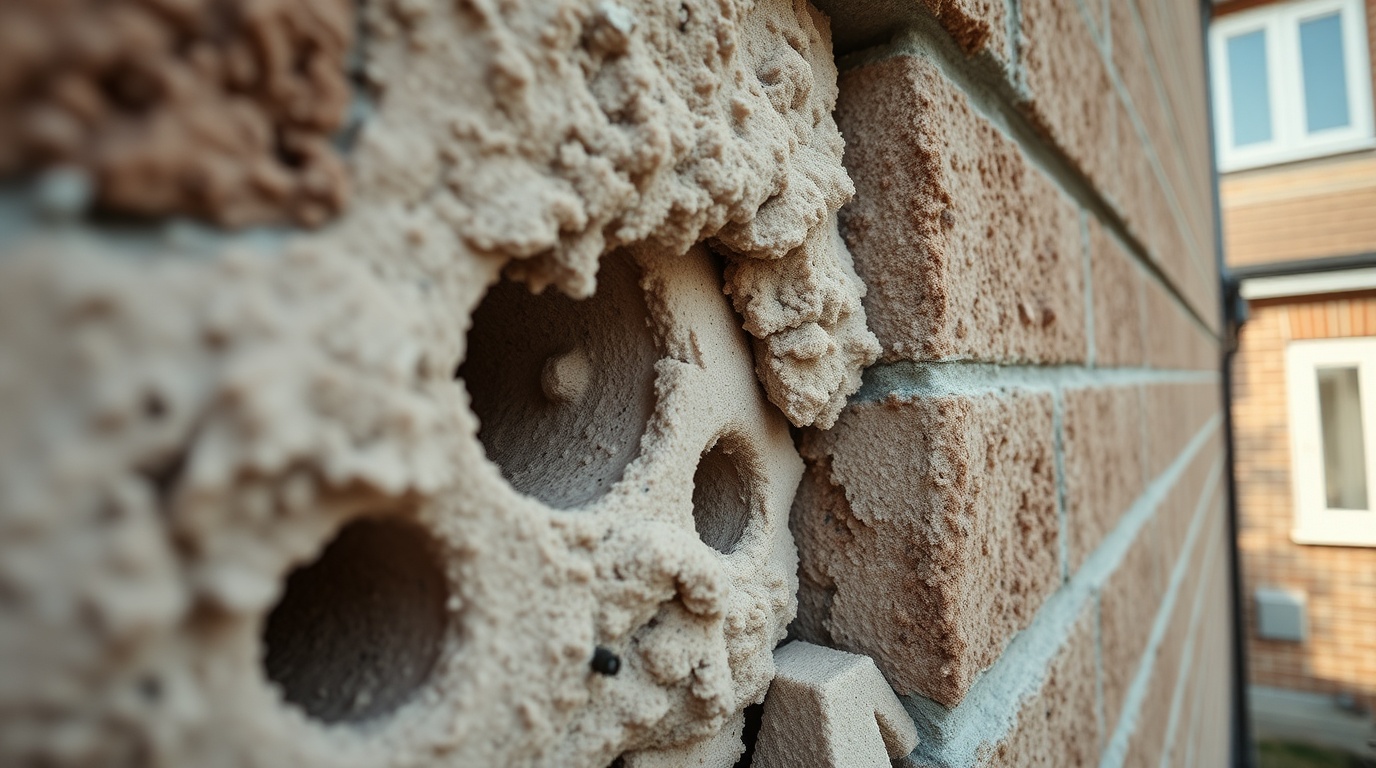
The short answer
Yes — cavity wall insulation can bridge the damp proof course (DPC). The DPC is a horizontal barrier near the base of the wall that stops ground moisture rising into the structure; in a cavity wall it works alongside the clear cavity, which should be kept open and drained below DPC level. If insulation fill extends or slumps below the DPC, or if debris and fill sit in the cavity base, that material can carry moisture from the wet ground upward past the barrier — effectively short-circuiting it. The result looks like rising damp: a tide mark and salts low on the inner wall. Correct installation keeps fill above the DPC and the cavity base clear, which is why DPC bridging is an installation fault rather than an inherent flaw.
The damp proof course only works if nothing bridges it, and cavity fill in the wrong place can do exactly that. Understanding how the DPC and cavity work together explains the risk.
DPC bridging at a glance
- DPC jobstops ground moisture rising
- Bridge causefill below DPC level
- Alsodebris in cavity base
- Resultdamp mimicking rising damp
- Correct installfill above DPC, clear base
How the DPC and cavity work together
Near the base of a wall sits the damp proof course — historically slate or bitumen, now usually a tough plastic membrane — bedded in the mortar to form a continuous horizontal barrier. Moisture in the ground cannot pass upward through it, so the masonry above stays dry. In a cavity wall, the open cavity below DPC level adds protection: it keeps the wet outer leaf separated and lets any water drain to the base and out. For both defences to work, the cavity must be clear below the DPC and any insulation must stop above it. Anything that connects the damp lower zone to the dry wall above provides a bridge for moisture.
It helps to think of the DPC as a deliberate gap in the chain of damp masonry. The bricks below it are in contact with moist ground and are expected to be damp; the membrane breaks the upward path so the bricks above stay dry. The open cavity reinforces that break, because water cannot cross an air gap. Both protections depend on the same thing — nothing solid spanning the line of the DPC. The moment a continuous material reaches from the wet zone below to the dry wall above, it offers moisture a route around the barrier, and the membrane, though perfectly intact, is simply bypassed. This is the key to understanding DPC bridging: the damp proof course has not failed at all. It is still doing its job; the problem is that something has been allowed to go around it.
How insulation bridges the DPC
Bridging happens when fill or debris occupies the part of the cavity that should stay clear:
- Fill installed too low — insulation injected below DPC level sits against damp masonry and wicks moisture upward.
- Slumped fill — material that has settled can drop below the DPC and pool at the cavity base.
- Mortar droppings and rubble — debris left in the cavity base during the original build forms its own bridge, and fill can lock it in place.
Once a continuous damp path exists across the DPC, ground moisture is drawn up into the wall above, appearing as a low tide mark and salt deposits on the inner surface — the classic look of rising damp, but with a different, fixable cause.
| Bridge mechanism | Where | Visible sign |
|---|---|---|
| Fill below DPC | cavity base | low damp band, salts |
| Slumped material | dropped to base | patchy low damp |
| Debris in cavity | base ledge | localised rising-type damp |
| Correct install | fill above DPC | no DPC bridging |
Indicative guidance. Source: Property Care Association.
Diagnosis and why it matters
DPC bridging is worth identifying precisely because it mimics rising damp but is caused by the cavity, not a failed DPC. A surveyor will locate the DPC, check whether fill or debris sits below it using a borescope at low level, and take moisture readings up the wall to see how high the damp reaches. They also rule out external bridging — raised ground levels, paths or render carried over the DPC outside. The remedy differs from a DPC repair: clearing the cavity base and ensuring insulation is held above the DPC removes the bridge, after which the wall can dry. Treating it as ordinary rising damp, by injecting a new chemical DPC, may not solve a problem that is actually a cavity bridge.
Why getting the diagnosis right saves money
DPC bridging matters out of proportion to how common it is, because it is so often misdiagnosed and mistreated. The low tide mark and salts it produces look exactly like classic rising damp, and the standard response to rising damp — injecting a new chemical damp proof course and replastering — does nothing to fix moisture that is crossing an intact DPC via fill or debris in the cavity base. The wall stays damp, the new plaster eventually stains again, and money has been spent on the wrong remedy. The same applies in reverse: assuming every low-level damp problem is a cavity bridge when it is genuinely a failed DPC leads to clearing a cavity that was never the issue. The way to avoid both errors is a methodical diagnosis that locates the DPC, uses a low-level borescope to see whether fill or rubble sits below it, takes moisture readings up the wall to map how high the damp reaches, and checks the outside ground levels — raised paths, patios, flower beds or render carried down over the DPC all bridge it externally and produce identical symptoms. Only once the actual moisture path is established does the right fix become clear: clearing the cavity base and holding insulation above the DPC for a true cavity bridge, lowering ground levels or stripping over-applied render for an external bridge, or addressing the DPC itself for genuine rising damp. Spending on the correct cause first is what turns a recurring damp patch into a permanent repair.
Frequently asked questions
Is DPC bridging the same as rising damp?
The symptoms look the same — a low tide mark and salts — but the cause differs. True rising damp comes from a failed or absent DPC, while DPC bridging is moisture crossing an intact DPC via fill or debris in the cavity base.
How do I know if my cavity is bridged at the base?
A surveyor uses a low-level borescope to see whether fill or rubble sits below the DPC, alongside moisture readings up the wall. Raised external ground levels covering the DPC are checked at the same time.
Does fixing DPC bridging mean removing the insulation?
Often only the lower, bridging material and any debris at the cavity base need clearing, so the cavity is open below the DPC again. Where slumping caused fill to drop, broader extraction may be needed before re-insulating correctly.
Sources & further reading
Figures on this page are typical UK ranges drawn from published sources and depend on your specific property. They are guidance, not a quotation.