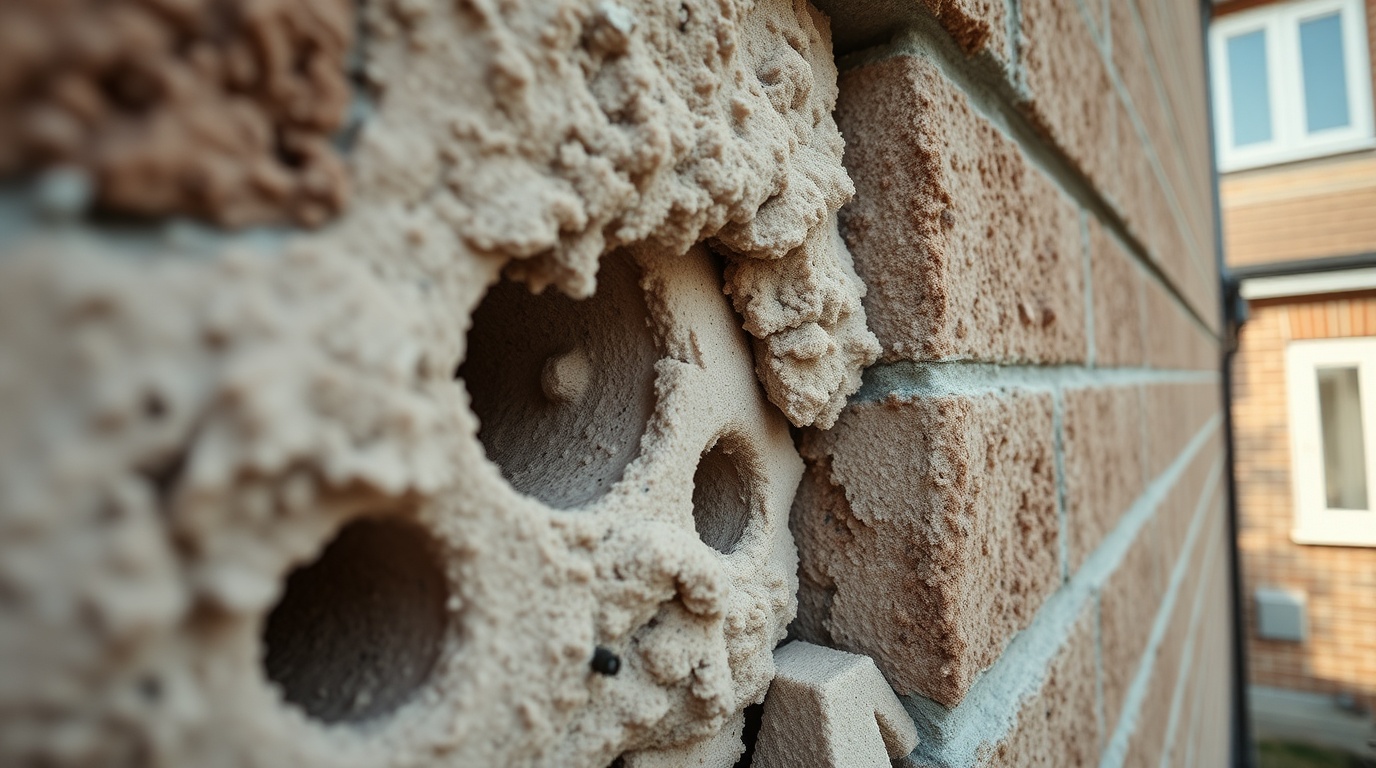
The short answer
Yes — coastal and exposed houses are the highest-risk properties for damp from cavity wall insulation. The reason is wind-driven rain: the BRE (Building Research Establishment) divides the UK into exposure zones, and homes on the coast, on hills, or in the wet west and north often sit in zone 3 (severe) or zone 4 (very severe). There, rain is driven hard against the wall, saturating the outer leaf and, if the fill is unsuitable or poorly installed, bridging moisture across the cavity to the inside. Many guidance documents advise that full-fill injected insulation is unsuitable for the most exposed walls without careful assessment. On a sound, sheltered wall the risk is low; on a battered, weather-facing one it is real.
Exposure is the factor most likely to turn cavity fill into a damp problem, and coastal homes feel it most. Understanding the BRE zones explains why the same insulation behaves differently in different locations.
Exposure and damp risk
- Driverwind-driven rain
- Highest riskBRE zones 3 and 4
- Typical locationscoast, hills, wet west / north
- Mechanismsaturated fill bridges cavity
- Guidancefull-fill often unsuitable when severe
How BRE exposure zones work
The amount of rain hitting a wall is not the same everywhere. The BRE classifies the UK into four exposure zones based on local wind and rainfall data, from zone 1 (sheltered) through to zone 4 (very severe). The wet, windy west and north — much of Wales, the south-west, north-west England, and Scotland — and almost all coastal areas fall into the higher zones, where walls receive heavy, frequent wind-driven rain. The outer leaf of brickwork can become fully saturated in these conditions. A cavity is meant to cope with that by draining water away, but the more severe the exposure, the harder the fill has to work to avoid carrying moisture across.
The practical point of the zones is that the same fill in the same wall behaves differently depending on where the house stands. A bonded-bead or mineral-wool system that performs perfectly on a sheltered suburban semi in the Midlands can be the wrong choice on an identical wall on an Atlantic-facing headland, simply because the second wall is wetted far more often and for far longer. Exposure is also directional: even within one house, the elevation facing the prevailing wet wind — usually the south-west in much of the UK — takes a far heavier beating than the sheltered side, which is why damp from cavity fill so often appears on just one wall while the rest of the house stays dry. Knowing your zone, and which wall faces the weather, is the starting point for judging whether your fill was a sensible choice or a risky one.
Why exposed walls overwhelm the fill
On a severely exposed wall, several things conspire:
- The outer leaf stays saturated for long periods, so any fill touching it absorbs water.
- Wind drives moisture inward, pushing it through gaps and against the fill rather than letting it drain.
- Defects in render, pointing or brick — common on weather-beaten walls — let water flood the cavity.
- Once the fill is wet, it bridges moisture to the inner leaf and conducts heat, giving both penetrating damp and cold spots.
This is why guidance often says full-fill injected insulation should be used with caution, or avoided, on the most exposed walls unless a careful suitability assessment supports it.
| BRE zone | Exposure | Cavity-fill consideration |
|---|---|---|
| Zone 1 | sheltered | generally low risk |
| Zone 2 | moderate | usually suitable if sound |
| Zone 3 | severe | careful assessment needed |
| Zone 4 | very severe | full-fill often unsuitable |
Indicative classification. Source: BRE exposure zones / CIGA guidance.
What suitability assessment should cover
For a coastal or hill-top home, the pre-installation assessment is what prevents damp, and any failure to do it properly is a common cause of problems. A competent assessment checks the property's exposure zone, the condition of the outer leaf (render cracks, soft pointing, spalled brick), the cavity width and cleanliness, and whether the chosen material is rated for that exposure. On the most severe walls, options such as repairing and weatherproofing the outer leaf first, or choosing a system designed for high exposure, may be appropriate. Where damp has already appeared, a borescope confirms whether saturated or bridging fill is the cause, and extraction may be needed so the wall can dry.
It is worth being clear about what a good assessment is checking for on an exposed wall, because the failure mode is specific. The risk is not that the air in the cavity gets wet — it is that the fill itself forms a continuous damp path from the saturated outer brick to the dry inner leaf. A clean, open cavity breaks that path; a cavity packed with material that has soaked up driving rain reconnects it. So the assessor is really asking three linked questions: how wet does this wall get, how good is the outer leaf at keeping the worst of that water out, and will the chosen material shed water or hold it. On a sheltered wall the answers rarely matter much. On a battered coastal wall all three have to line up, and if any one of them is weak — heavy exposure, cracked render, or a water-retaining fill — the cavity's protection can be lost in the very spot where the house most needs it.
Why coastal walls are a special case
Coastal and clifftop homes combine several stresses that make them the hardest cavity walls to get right. Beyond the raw quantity of wind-driven rain, sea exposure adds salt-laden air that is hygroscopic — it attracts and holds moisture — so the outer leaf can stay damp for longer and salts can accelerate the decay of pointing and the corrosion of wall ties. Strong, persistent onshore winds drive rain into the wall at pressure rather than letting it run gently down, forcing moisture into fine cracks and through porous brick that a sheltered wall would shrug off. The same wind can strip heat from the wall, so any failed fill behind it reads colder still. For these properties the condition of the outer leaf is doubly important: render must be sound and crack-free, pointing intact, and any weatherproofing maintained, because once water gets into the cavity in volume even a good fill struggles. This is why guidance treats severe and very severe exposure with caution, and why some exposed walls are better served by weatherproofing the outer leaf or by external or internal insulation systems designed to manage driving rain, rather than full-fill injection. None of this rules cavity insulation out at the coast, but it raises the bar for the assessment and the ongoing maintenance the wall needs to stay dry.
Frequently asked questions
How do I find my home's exposure zone?
Exposure zones are based on BRE wind and rainfall mapping for your location and are used by installers during the suitability assessment. Coastal, hill-top and wet-region homes are usually in the higher (severe or very severe) zones.
Is full-fill cavity insulation banned in exposed areas?
It is not banned, but guidance advises caution and proper assessment for severe and very severe exposure, where full-fill injected insulation may be unsuitable. The wall condition and chosen system decide whether it is appropriate.
My exposed wall is damp after filling — what now?
Have the cavity inspected with a borescope to confirm whether the fill is saturated or bridging, and the outer leaf checked for defects. Repairing the external wall and extracting failed fill so it can dry is the usual route.
Sources & further reading
Figures on this page are typical UK ranges drawn from published sources and depend on your specific property. They are guidance, not a quotation.