The short answer
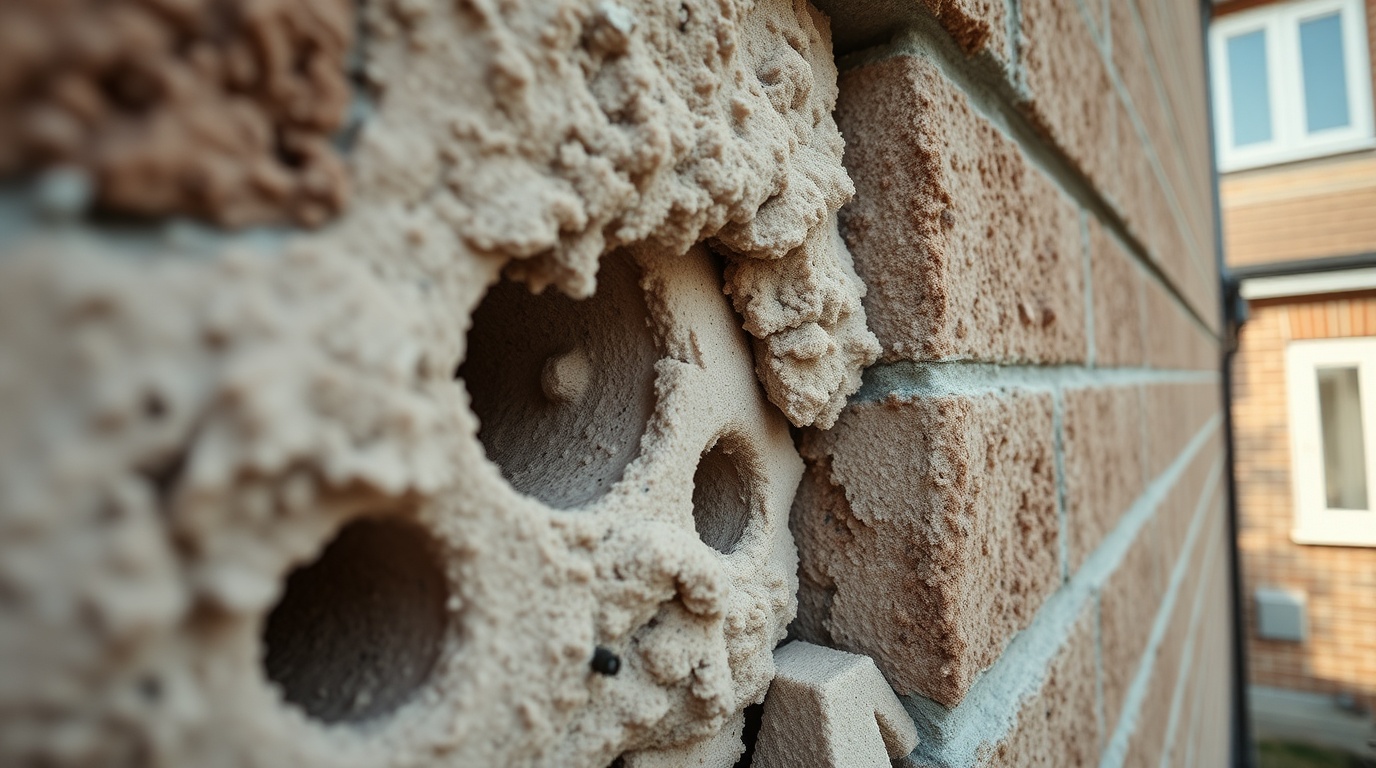
Yes — wrongly installed cavity insulation is one of the recognised causes of penetrating damp. The cavity exists to keep the wet outer leaf separated from the dry inner leaf; rain that soaks the outside drains down the cavity and out, never reaching the inside. Bad installation breaks that defence by bridging the gap: fill packed unevenly so it touches both leaves, clumped or slumped material, or insulation fitted in a wall that was never suitable — too narrow, too exposed, or with cracked render. Driving rain then tracks through the fill to the inner leaf and shows as a defined wet patch on weather-facing walls, worse after wind-driven rain. This is true penetrating damp, distinct from rising damp or condensation.
Penetrating damp from insulation is almost always an installation or assessment failure, not an inherent flaw. Knowing how it arises explains the signs and why the wall behaves as it does.
Causes of penetrating damp
- Bridging filltouches both leaves
- Slumped / clumpeduneven, wet pathways
- Unsuitable wallnarrow cavity, cracked render
- Severe exposuredriving rain overwhelms fill
- Signwet patch after wind-driven rain
How bridging carries rain inside
In a healthy cavity, the air gap is a capillary break: water cannot jump the gap, so it runs down the inner face of the outer leaf and exits through weep holes at the base. Penetrating damp occurs when something gives the water a continuous path across. Wrongly installed fill does this when it is packed too densely against both leaves, when clumps of bead or matted mineral wool span the gap, or when the material has soaked up rain and become a wet bridge. Mortar snots and rubble left in the cavity during the original build make it worse. Once that bridge exists, rain on the outer brick is wicked across to the inner leaf and into the room.
The mechanism is worth picturing because it explains why the damp is so often localised rather than general. Water does not need the whole cavity to be bridged to cause a problem — a single clump of matted fibre, one over-packed zone, or a mortar bridge spanning the gap is enough to create a wick at that point. Rain soaking the outer leaf finds the bridge, crosses it, and emerges as a discrete damp patch on the inner wall directly behind it, while the rest of the wall stays dry. That is why penetrating damp from failed fill tends to show as defined stains in particular spots rather than an evenly damp wall, and why the patches reliably reappear in the same places after the wind blows rain at that elevation. Each patch is, in effect, marking where the cavity's protection has been short-circuited.
Installation and assessment failures
The faults that lead to penetrating damp are usually decisions made before or during the injection:
- Filling an unsuitable wall — a cavity narrower than the material needs, rubble-filled or partial cavities, or solid/stone walls mistaken for cavities.
- Ignoring the exposure rating — fitting a fill not rated for a BRE severe (zone 4) location facing the prevailing wind and rain.
- Pre-existing defects — cracked render, failed pointing, or porous brick that lets water flood the cavity, which were not repaired first.
- Poor injection — uneven density, voids and clumping from rushed or careless work.
| Installation error | How it bridges | Result |
|---|---|---|
| Over-dense fill | presses both leaves | continuous wet path |
| Wrong exposure rating | fill saturates | rain crosses cavity |
| Unrepaired render cracks | water floods cavity | soaked, bridging fill |
| Voids and clumps | uneven wet spans | localised wet patches |
Indicative guidance. Source: CIGA / BRE exposure classification.
Telling it apart from other damp
Penetrating damp from failed fill has a distinctive behaviour that separates it from rising damp and condensation. It appears as a defined patch on the inside of an external wall, worsens after heavy, wind-driven rain and partly dries in settled weather, and is concentrated on the most weather-exposed elevations rather than uniformly. Rising damp, by contrast, sits as a tide mark low on the wall with salt deposits and is constant; condensation tracks indoor humidity and cold surfaces. A surveyor confirms penetrating damp from the cavity with a borescope showing bridging or saturated fill, supported by moisture-meter mapping and a check of the external brick, render and pointing.
The single most useful clue you can gather yourself is timing against the weather. Penetrating damp from a bridged cavity is rain-driven, so it darkens and spreads during and just after spells of heavy, wind-blown rain and then fades as the wall dries in settled weather. Condensation does the opposite — it is worst in cold, still, closed-up conditions when indoor humidity is high, and eases when the home is aired. Rising damp barely changes with the weather at all, holding a steady tide mark near the floor year-round. Watching how a damp patch responds over a few weeks therefore tells you a great deal before any instrument is involved, and it helps a surveyor focus the borescope on the right wall: a patch that tracks the wind points firmly at the cavity, whereas one tied to cooking and bathing points back indoors.
What good installation should have prevented
Penetrating damp from cavity fill is so often avoidable that it is worth setting out what a competent installation should have involved, because the gap between that and what happened usually explains the problem. Before any injection, a registered installer is expected to carry out a pre-installation survey: confirming there is a genuine, clear cavity of adequate width; checking the condition of the outer leaf for cracks, soft pointing and spalled brick; identifying the property's BRE exposure zone; and choosing a material rated for that exposure. The injection itself should achieve even density with no voids or clumps, and the cavity should be left clear at the base and around the damp proof course. Where any of these steps is skipped — filling a defective or over-exposed wall, or injecting unevenly — the conditions for bridging are created at the outset. This is why penetrating damp after cavity work is generally treated as a workmanship or assessment failure rather than bad luck. It also shapes the remedy: simply re-filling the same wall without fixing the outer-leaf defects or reassessing the exposure tends to reproduce the fault. The durable answer is to repair the external wall, extract bridging or saturated material, let the wall dry, and only then decide whether re-insulation is appropriate and, if so, with a system suited to the wall and its exposure.
Frequently asked questions
How is penetrating damp from insulation different from rising damp?
Penetrating damp appears as a defined patch on external walls and worsens after wind-driven rain, while rising damp sits as a constant low tide mark with salts. They are diagnosed and treated differently, so identifying which you have matters.
Can the installer be held responsible?
If the work was covered by a guarantee, schemes such as CIGA may apply to defective installation, and a registered installer should have assessed the wall's suitability and exposure first. Keep paperwork and seek an independent survey to establish the cause.
Does the insulation always need removing?
Not always. If the cause is a repairable external defect and the fill is sound, fixing the defect may be enough. Where the fill is bridging or saturated, extraction is usually needed so the wall can dry and the cavity work again.
Sources & further reading
Figures on this page are typical UK ranges drawn from published sources and depend on your specific property. They are guidance, not a quotation.