The short answer
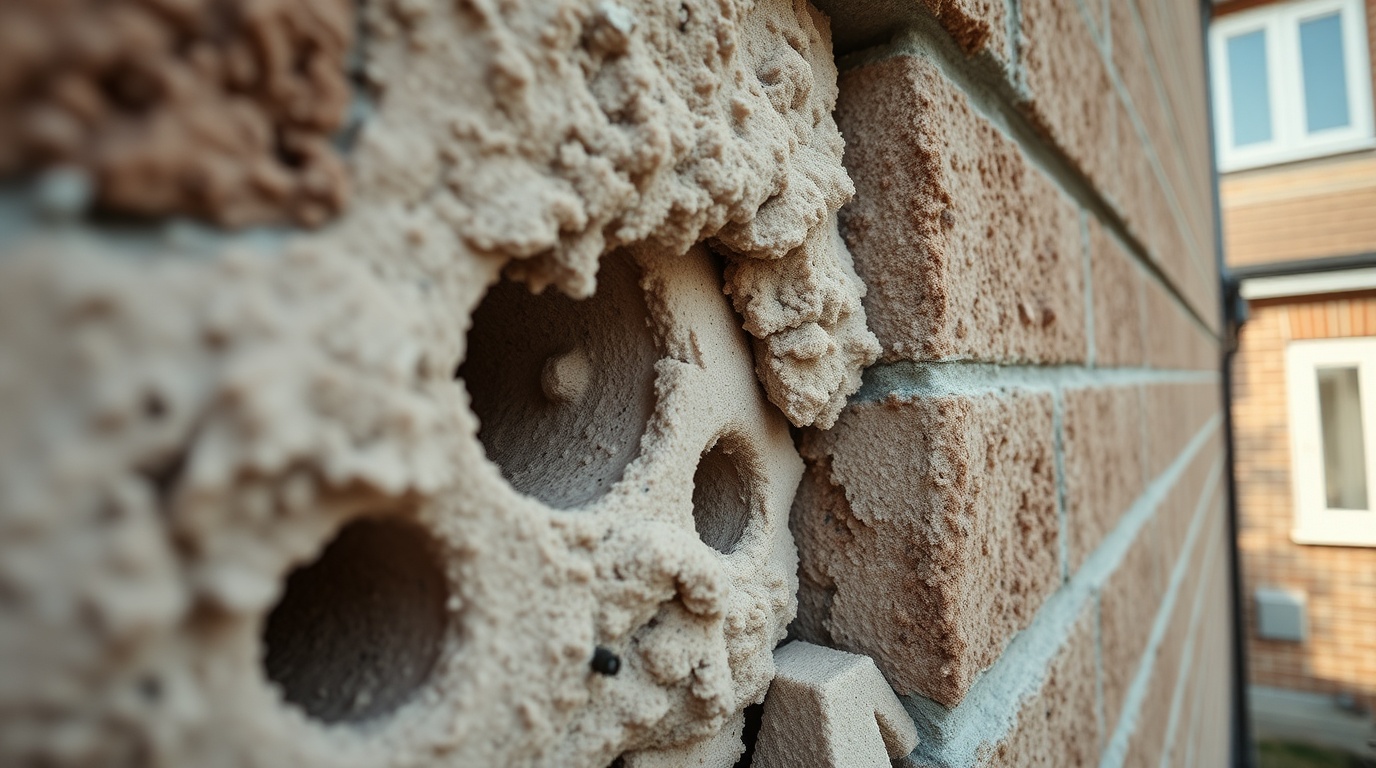
Yes — failed cavity insulation is a classic cause of cold spots and condensation. Where fill has slumped and left a void, or has saturated and now conducts heat, that part of the inner wall runs several degrees colder than the surrounding plaster. This is a form of cold bridging — a localised weak point in the thermal envelope. Warm, moisture-laden household air meeting that cold surface cools, its relative humidity climbs, and water deposits as condensation, often followed by black mould. The effect is usually localised to the failed zone — a cold patch with damp and mould above or around it — rather than spread evenly across the room, which is exactly what a thermal imaging survey reveals.
Cold spots and condensation go hand in hand, because a cold surface is what makes air give up its moisture. Failed fill creates those cold surfaces directly, and the link is one of the clearest in building pathology.
Cold spots and condensation
- Causevoid or saturated fill
- Mechanismcold bridging at the inner leaf
- Effectsurface condensation, mould
- Patternlocalised, not uniform
- Survey toolthermal imaging camera
Cold bridging from failed fill
A cold bridge (or thermal bridge) is any part of the wall where heat escapes faster than the surrounding area, leaving the inner surface colder. Intact cavity insulation removes most cold bridging by keeping the whole wall warm. When the fill fails, it reintroduces it: a void from slumping is effectively uninsulated, and wet fill conducts heat far better than dry, so warmth is drawn out through that zone. The inner plaster there drops below the temperature of the rest of the wall — sometimes by several degrees — creating a defined cold patch. Because the rest of the wall may still be insulated, the contrast is sharp, which is why these cold spots are so visible on a thermal camera.
The wet-fill case is worth dwelling on, because it is counter-intuitive. People assume insulation either works or is simply absent, but saturated insulation is worse than no insulation at all in thermal terms. Dry mineral wool or bead works by trapping millions of tiny pockets of still air, and still air is a poor conductor of heat — that trapped air is what keeps the wall warm. When the fill soaks up water, those air pockets are replaced by water, which conducts heat many times faster than air. The material that was meant to slow heat loss now actively draws warmth out of the wall, so a wet patch of fill can leave the inner surface colder than a bare, unfilled cavity would. That is why a wall with saturated fill often feels strikingly cold to the hand and condenses heavily, and why simply leaving wet fill in place does not solve the cold-spot problem — the water has to go before the wall can warm up.
Why cold spots condense moisture
Condensation is governed by the dew point: the temperature at which air can no longer hold its water vapour. Indoor air carries moisture from daily living, and when it touches a surface colder than the dew point, that moisture deposits as liquid water. A cold spot from failed fill is frequently below the dew point on a winter evening, so it collects condensation while the warmer surrounding wall stays dry. Even where droplets are not obvious, the surface humidity stays high enough for mould to grow. This is why cold spots, condensation and black mould appear together and in the same place — they are three stages of one process driven by the cold surface.
| Stage | What happens | Visible result |
|---|---|---|
| Fill fails | void or saturation | cold spot on inner wall |
| Air meets cold surface | cools below dew point | condensation forms |
| Surface stays damp | high surface humidity | black mould growth |
| Pattern repeats | across failed zones | localised damp map |
Indicative guidance. Source: Property Care Association.
Finding and confirming cold spots
The most direct way to confirm failed-fill cold spots is thermal imaging, ideally on a cold day with the heating on so the temperature difference is clear. The camera shows failed zones as distinct cool patches against the warmer insulated wall, mapping where the fill has slumped or saturated. A borescope then confirms the cause behind each cold spot — void, settlement or wet material. Moisture-meter readings and a hygrometer reading of room humidity round out the picture, separating pure surface condensation from any penetrating damp. With the cold zones mapped, the fix — extracting failed fill so the wall can be re-insulated and warmed — can be targeted accurately.
Telling cavity cold spots from structural ones
Not every cold spot on a thermal image comes from failed fill, and a careful diagnosis separates the two because the remedies differ entirely. Structural cold bridges are built into the wall: concrete lintels over windows and doors, steel wall ties spanning the cavity, the reveals around openings, and junctions at floors, ceilings and corners all conduct heat more readily than the insulated wall around them. On a thermal image these tend to show as regular, predictable lines and points — a straight cool band along a lintel, a grid of cool dots where ties sit, a cold frame around a window — and they appear even on walls with sound insulation. A failed-fill cold spot, by contrast, is usually a broader, irregular patch that does not line up with a structural feature: a cool band high on the wall from slumping, or a blotchy cold area where the fill has saturated. The two can coexist, which is why the borescope is decisive — drilling into a suspected failed zone confirms whether there is a genuine void or wet material behind it, or whether the cold reading is just a lintel or tie doing what it always does. Getting this distinction right matters: a structural bridge may be improved by internal insulated detailing, whereas a failed fill needs the cavity addressing, and treating one as the other wastes effort. A practical tell is scale and shape: structural bridges are thin and geometric because the cold element itself is thin, while a failed fill chills a wider area of the inner leaf. If the cold reading is a neat line over a window or a regular row of dots, suspect the structure; if it is a soft, spreading patch with no obvious feature behind it, the cavity is the more likely culprit and worth a borescope check.
Frequently asked questions
How cold does a wall have to get to condense?
It only needs to fall below the dew point of the room air, which on a humid winter evening can be well within reach for a cold spot from failed fill. The wider the gap between the cold patch and the rest of the wall, the more it condenses.
Will more heating stop the condensation?
Heating raises surface temperatures temporarily and can reduce condensation, but it does not restore the missing insulation and adds cost. A persistent cold spot from failed fill keeps condensing until the cavity fault is addressed.
Can thermal imaging see through the wall?
It does not see inside the cavity; it reads surface temperatures, revealing where the inner wall is cold. A borescope is still needed to confirm whether a void, slumping or saturation lies behind each cold spot.
Sources & further reading
Figures on this page are typical UK ranges drawn from published sources and depend on your specific property. They are guidance, not a quotation.