The short answer
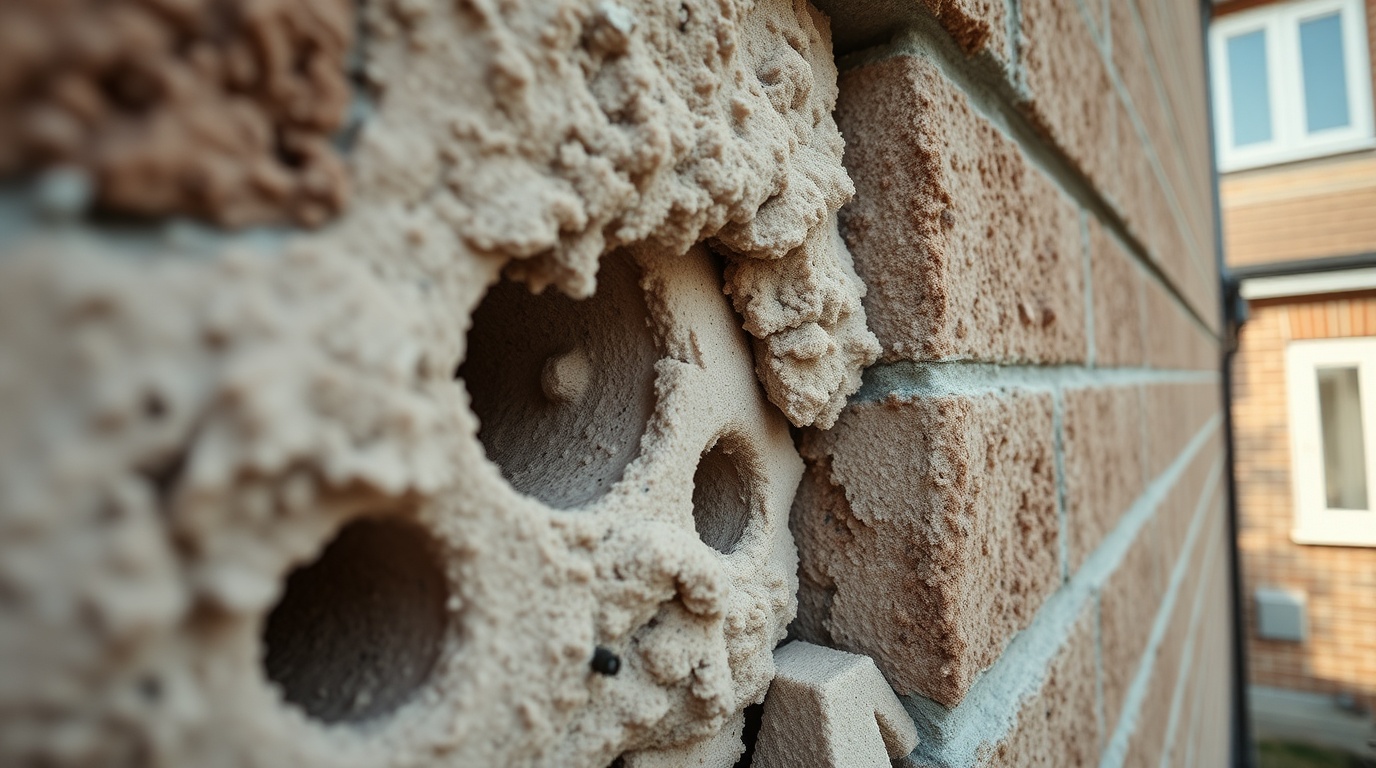
Yes — failed cavity insulation can leave staining, salt blooms and tide marks on walls, inside and out. Where saturated or bridging fill carries rainwater across the cavity, the moisture reaches plaster or brick and evaporates at the surface, leaving behind brown or yellow stains and white salt deposits (efflorescence) as dissolved minerals are drawn out. The drying edge often forms a visible tide mark — a wavy line between damp and dry. On the outside, you may see horizontal staining or streaks where moisture tracks through. A key distinction from rising damp is position: failed-fill tide marks follow the bridging path on weather-facing walls and worsen after wind-driven rain, rather than sitting low down at a constant ground-level height.
Stains and tide marks are the visible record of where moisture has been and dried. Reading their position and behaviour helps tell failed cavity fill from rising damp and other causes.
Staining and tide marks
- Brown / yellow stainmoisture drying at surface
- White bloomefflorescence (salts)
- Tide markedge between damp and dry
- Failed-fill cluefollows bridging on weather walls
- Rising-damp clueconstant low band with salts
Why moisture leaves stains and salts
When water moves through masonry and plaster it dissolves soluble salts from the materials and carries them along. At the surface, the water evaporates but the salts are left behind, forming a white, powdery efflorescence or, where staining minerals are present, brown and yellow marks. The tide mark appears at the boundary where the wall is wet enough to migrate moisture but dry enough at the edge for evaporation — so it traces the furthest reach of the damp. With failed cavity fill, the water source is rain bridged across the cavity, so the staining clusters where that bridge delivers moisture to the inner leaf, often part-way up the wall rather than at the base.
The height at which a stain appears is therefore one of the most useful things to read, because it points back to the source of the water. Rising damp can only climb so far before gravity and evaporation stop it, so its tide mark sits low, typically below a metre. A stain that appears halfway up a wall, around a window, or near the ceiling cannot be rising damp — the water has not come from the ground, so it must have arrived another way, and a bridged cavity delivering rain to the inner leaf is a prime candidate. The shape matters too: rising damp produces a roughly level, horizontal band following the floor line, whereas penetrating damp from failed fill tends to leave more irregular blotches and runs that map onto wherever the cavity is bridged, with no particular respect for the floor line. Position and shape together often narrow the cause before any meter is used.
Inside, outside, and the rising-damp comparison
Failed-fill staining can show in several places:
- Internally — patches and tide marks on the inside of external walls, worse after wind-driven rain, partly drying in settled spells.
- Externally — horizontal streaks or staining on the brickwork, sometimes around the original drill-hole grid, and salt blooms where the wall stays wet.
The crucial comparison is with rising damp, which also leaves a tide mark and salts but behaves differently. Rising damp sits as a constant horizontal band low on the wall (rarely above about a metre), present in all weather, fed from the ground. Failed-fill staining is tied to rain events and the bridging path, so its position and timing give it away.
| Feature | Failed-fill staining | Rising damp |
|---|---|---|
| Height | varies, follows bridge | low band near floor |
| Timing | worse after wind-driven rain | constant |
| Walls affected | weather-facing | any, ground level |
| Salts / tide mark | at bridging surface | at top of rising band |
Indicative comparison. Source: Property Care Association.
Confirming the source of the stain
Because several damp types leave similar marks, the stain alone does not prove the cause. A surveyor confirms it by matching the staining to the cavity: a borescope checks whether the fill behind the stained area is saturated or bridging, moisture meters map how the damp behaves across the wall, and the external leaf is examined for cracked render, failed pointing or porous brick letting water in. Thermal imaging may show an associated cold spot. Watching how the stain changes with the weather is also telling — failed-fill staining responds to rain, rising damp does not. Only with that evidence is it fair to attribute the staining to the insulation rather than treating it as rising damp. The cost of getting this wrong is real: a wall mis-diagnosed as rising damp may be given an injected chemical damp course it never needed, while the true source — saturated fill behind a weather-facing wall — keeps feeding moisture and the stains keep coming back through the new plaster.
What the salts can tell you
The deposits left behind by drying moisture are not just a blemish — they carry information about the damp. Where water has passed through masonry and mortar, it dissolves and transports building salts, and the type and pattern of those salts hint at the journey. Efflorescence — the loose, white, powdery bloom — usually means relatively fresh water reaching the surface and evaporating there, common where bridging fill is delivering rain to the inner leaf. Hygroscopic salts driven up by long-term rising damp, by contrast, attract moisture from the air and can keep a wall looking damp even in dry weather, which is one reason a contaminated band near the floor behaves differently from a weather-driven patch higher up. A persistent tide mark marks the high-water line of migrating moisture, so a stable mark low on the wall points to rising damp, while a mark that advances and retreats with the weather points to penetrating damp from the cavity. None of this is a substitute for instruments — a surveyor still confirms the source with a borescope, moisture readings and an external inspection — but reading the salts and the tide line helps form the right hypothesis. It also explains why decoration alone fails: salt-contaminated plaster keeps drawing moisture and pushing salts through new paint, so genuinely affected plaster often has to be removed and replaced once the underlying water source has been stopped and the wall has dried.
Frequently asked questions
Are the white salt deposits harmful?
Efflorescence itself is not dangerous, but it signals that water is moving through the wall and drying at the surface. The concern is the ongoing dampness behind it, which can damage finishes and feed mould.
How can I tell a failed-fill tide mark from rising damp?
Rising damp forms a constant low band near the floor and does not change with the weather, while failed-fill staining follows the bridging path on weather-facing walls and worsens after wind-driven rain. Position and timing are the giveaways.
Will the stains go once the cause is fixed?
The wall stops getting wet once the source is removed — by repairing the outer leaf and extracting bridging fill — but existing salt-contaminated plaster may need replacing. Re-decorating before the wall has dried tends to let the marks return.
Sources & further reading
Figures on this page are typical UK ranges drawn from published sources and depend on your specific property. They are guidance, not a quotation.