The short answer
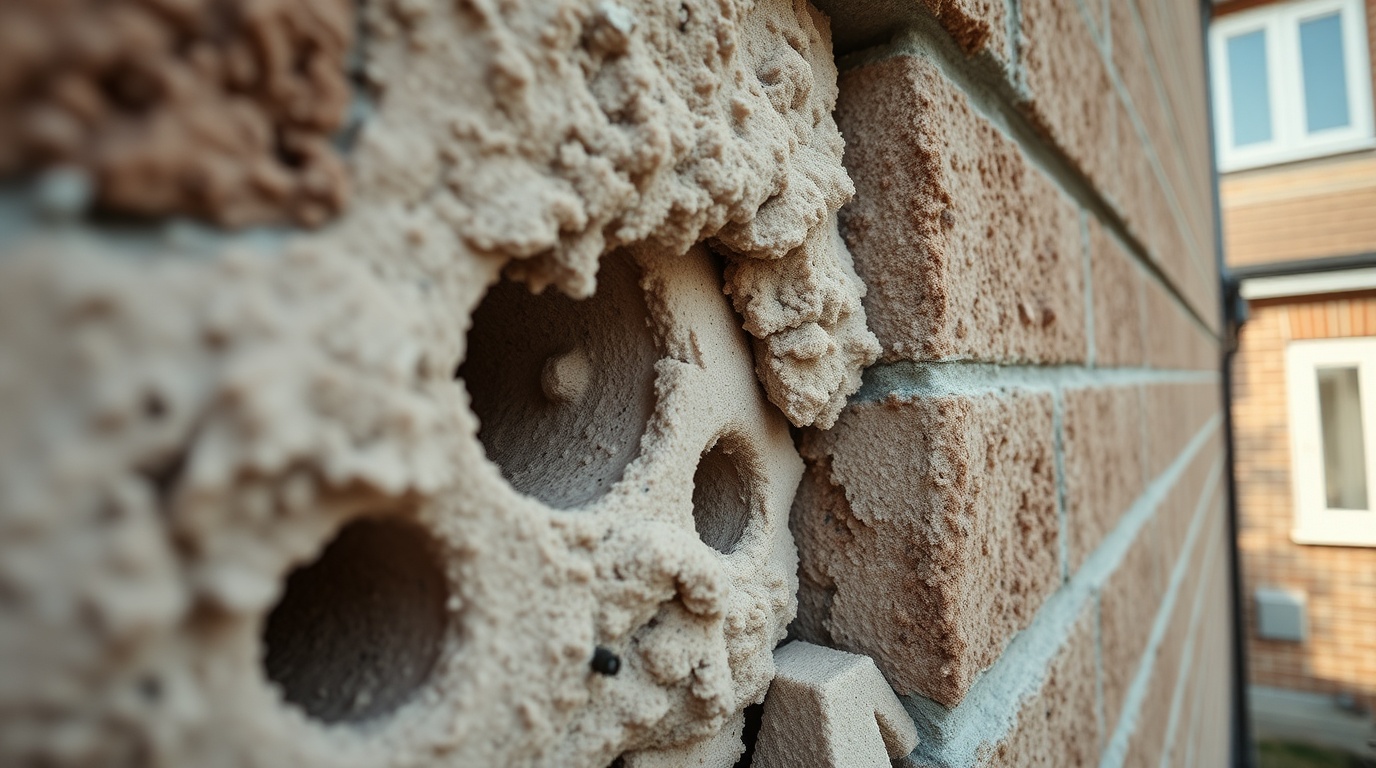
Blown mineral fibre is extracted by drilling holes into the mortar joints and vacuuming the loose fibre out under suction, almost always with the help of mechanical agitation to break up the matted material first. Unlike free-flowing EPS bead, blown fibre tends to clump, slump and absorb water, so a plain vacuum is rarely enough. Operatives use an air whip or rotating extraction tool fed through the drill holes to loosen the fibre, then draw it out with an industrial vacuum into sealed bags. A denser drilling pattern is used where the survey shows the fibre has slumped to the bottom of the cavity or bridged across to the inner leaf. Throughout, a borescope is used to confirm pockets behind wall ties and low in the wall are genuinely cleared.
Blown mineral fibre was one of the most common cavity fills installed in UK housing, and it is also one of the more troublesome to extract once it has aged, settled or taken on moisture.
Mineral fibre extraction
- AccessHoles drilled in mortar joints
- Key toolAir whip / mechanical agitator
- RemovalIndustrial vacuum into sealed bags
- Hardest caseDamp, slumped or bridged fibre
- CheckBorescope before and after
Why fibre needs more than suction
When blown mineral fibre is installed it is injected as loose strands that knit together to fill the cavity. Over years it can compact, slump downward and soak up water if the wall lets moisture in. By the time removal is needed, the fibre is often a damp, matted mass rather than a loose fluff.
A vacuum on its own will pull out the easy surface fibre but leave the compacted core behind. That is why extraction of fibre is more involved than bead removal — the material has to be broken up before it will come out. Leaving compacted pockets defeats the point of removal, especially when the reason for extraction was damp caused by that very material bridging the cavity.
The agitation-and-suction technique
The standard approach combines mechanical loosening with strong suction:
- Borescope survey to map where the fibre has slumped, where it is wet and where it bridges to the inner leaf.
- Drilling a pattern into the mortar joints — denser around slumped or damp zones and near the base of the wall where fibre settles.
- Air whip or rotating tool fed through the holes to agitate and break up the matted fibre into vacuum-able pieces.
- Industrial vacuum extraction drawing the loosened fibre out into sealed bags as the operative works methodically across each panel.
- Re-check with the borescope, re-drilling and re-vacuuming any pocket that remains.
Because fibre is dusty, dust suppression and protection of paths, sills and neighbouring property is part of a careful extraction.
How fibre compares with other fills
Knowing how fibre behaves under extraction explains why it sits in the middle of the difficulty scale:
| Fill type | Behaviour under suction | Extraction effort |
|---|---|---|
| EPS bead | Flows out freely | Easiest |
| Dry blown fibre | Vacuums with light agitation | Moderate |
| Damp/slumped fibre | Needs heavy agitation | Hard |
| UF foam | Set solid, must be broken up | Hardest |
Relative extraction effort by fill type. Damp blown fibre is markedly harder than the dry material it started as.
Frequently asked questions
Why is blown mineral fibre harder to remove than bead?
Bead is loose and free-flowing, so it pours out under suction. Blown fibre knits together and, over time, compacts, slumps and absorbs water, becoming a matted mass that has to be mechanically broken up with an air whip before a vacuum can extract it.
Can all the fibre be removed from the cavity?
A thorough extraction aims to clear the cavity fully, using a denser drilling pattern and a borescope to find and re-vacuum trapped pockets behind wall ties and at the base of the wall. Verification after extraction is what separates a complete clearance from a partial one.
Is removing mineral fibre dusty?
Yes. Breaking up and vacuuming fibre creates fine dust, so a careful contractor uses dust suppression and protects paths, window sills and neighbouring property. The extracted fibre is bagged and sealed for disposal.
Sources & further reading
- CIGA — Cavity Insulation Guarantee Agency
- Property Care Association — cavity wall insulation advice
- Energy Saving Trust — cavity wall insulation
Figures on this page are typical UK ranges drawn from published sources and depend on your specific property. They are guidance, not a quotation.