The short answer
Surveyors test for failed cavity wall insulation using three complementary methods. A borescope inspection is the key one: small holes are drilled through mortar joints at different heights and a camera views the fill directly to check for voids, slumping, clumping, saturation or bridging. Thermal imaging reads surface temperatures from inside on a cold day, revealing cold spots where insulation is missing or wet. Moisture meters and a hygrometer map dampness and indoor humidity, separating penetrating damp from surface condensation. A surveyor also examines the outer leaf — render, pointing, brick — and the property's exposure. No single test is conclusive; combining them gives a reliable verdict on whether the fill has failed and why.
A proper assessment does not guess from the symptoms; it looks inside the wall and measures. These are the standard tools and how a surveyor uses them together.
How surveyors test
- Borescopecamera inside the cavity
- Thermal imagingmaps cold spots
- Moisture meterlocates damp
- Hygrometerchecks indoor humidity
- External checkrender, pointing, exposure
Borescope inspection: the decisive test
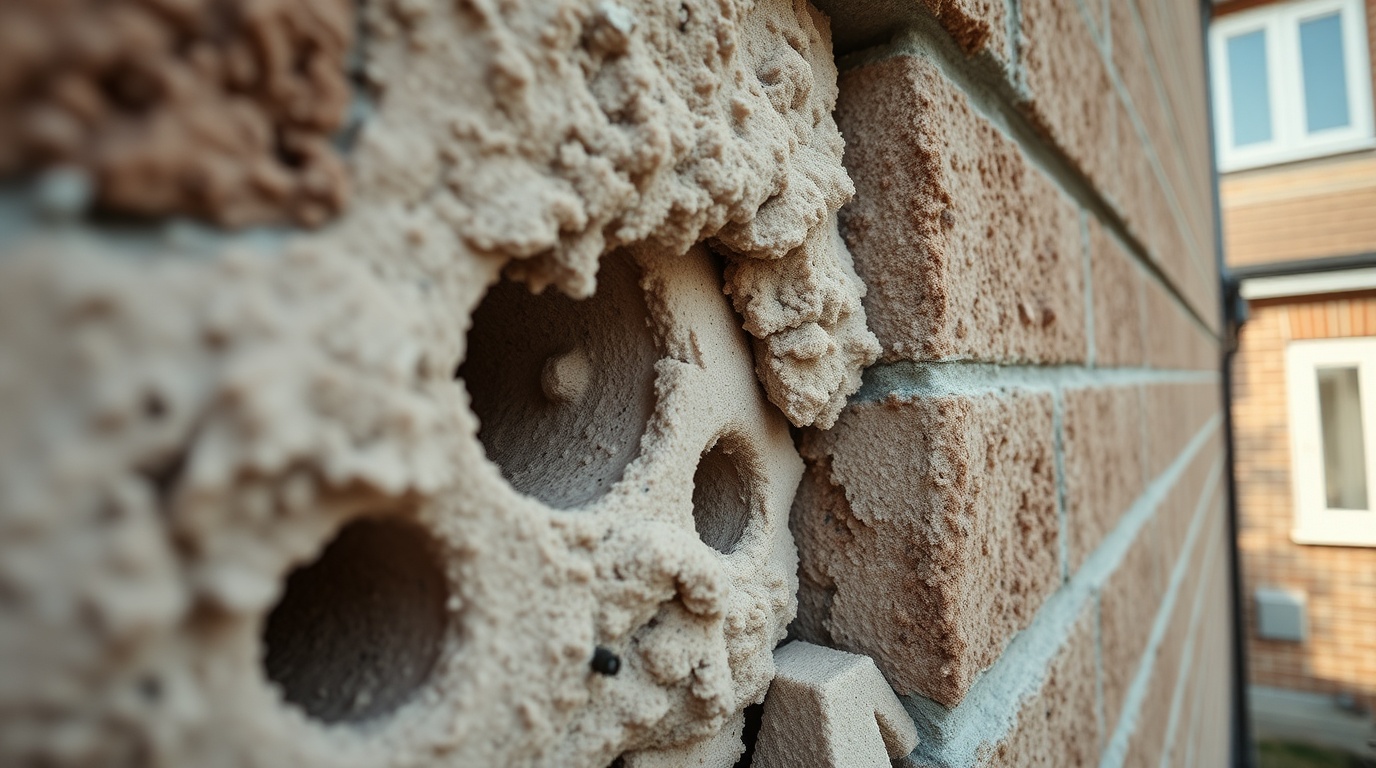
The borescope (or endoscope) is what actually confirms the condition of the fill. The surveyor drills a small hole, usually through a mortar joint, and inserts a slim camera to view the cavity. Holes are made at several heights and on several elevations — particularly the most exposed, weather-facing walls — because faults vary across a wall. Through the camera they can see whether there is a void (often near the top, from slumping), whether the fill is uneven or clumped from poor installation, whether it is dark and matted with moisture, and whether anything is bridging the two leaves. They also identify the material — mineral wool, bead or foam — because that affects both how it fails and how it would be removed. The number and placement of holes is what separates a real survey from a token one: a single hole into a sound patch can give a falsely reassuring result while a void or saturated zone a metre away goes unseen, so a careful surveyor takes readings at high level (where slumping leaves voids), at mid height, and low near the damp proof course (where fill and debris collect), repeating this on each elevation that shows symptoms. The holes are made through mortar joints and reinstated discreetly afterward, so the wall is left looking untouched.
Thermal imaging and moisture mapping
Two non-destructive tools support the borescope:
- Thermal imaging — an infrared camera reads the inner surface temperature. On a cold day with the heating on, failed zones show as cool patches against the warmer insulated wall, mapping where the fill has slumped or saturated and helping target where to drill.
- Moisture meters — these locate and grade dampness across the wall, distinguishing a wet, penetrating patch from drier areas.
- A hygrometer — reads room relative humidity, showing whether high indoor moisture and condensation are contributing alongside any fill fault.
Together these separate a genuine cavity failure from pure condensation or a leak. A point worth understanding is that thermal imaging shows temperature, not moisture: a cold patch on the camera could be a void, wet fill, or simply a structural cold bridge such as a concrete lintel or a wall tie, all of which read cool. That is exactly why the camera is used to target the borescope rather than to reach a verdict on its own — the camera says where to look, and the borescope says what is actually there. Likewise a high moisture-meter reading needs context: surface moisture from condensation behaves differently from deep moisture driven through a saturated cavity, and the hygrometer helps decide which by showing how humid the room air is to begin with.
| Method | What it shows | Destructive? |
|---|---|---|
| Borescope | actual fill condition | small drilled hole |
| Thermal imaging | cold spots / missing fill | no |
| Moisture meter | location of damp | no |
| External survey | outer-leaf defects, exposure | no |
Indicative methods. Source: CIGA / Property Care Association survey guidance.
Reading the results together
The skill is in combining the findings. A cold spot on the thermal image, a void or wet fill seen on the borescope at that spot, a raised moisture reading on the inner wall, and a saturated outer leaf from an external defect together build a clear case of failed fill causing damp. Conversely, high room humidity with no cavity void and dry fill points to a condensation problem instead. A surveyor also weighs the property's exposure zone and history — when the damp started relative to installation. The written report should state the fill type, its condition, the cause of any damp, and whether extraction is warranted, giving an evidence-based answer rather than an assumption.
Choosing an independent surveyor
Who carries out the assessment matters as much as the methods, particularly if there is a dispute about whether the fill caused damp. The most reliable approach is an independent survey by someone with no interest in selling either the original insulation or its extraction, so the verdict is led by the evidence rather than a sale. Surveyors with relevant credentials — for example membership of the Property Care Association for damp investigation, or chartered surveyors via RICS — bring recognised competence and a structured reporting standard. A good surveyor will set out their method in advance, explain how many borescope holes they will take and where, confirm whether thermal imaging and moisture mapping are included, and inspect the outside of the property as well as the inside, since exposure and outer-leaf condition are central to any cavity-damp diagnosis. The written report should record the fill type and condition, the cause of any damp, and a clear recommendation — leave, top up, or extract — with the evidence behind it. If the original installation was covered by a scheme such as CIGA, an independent report also provides the documented basis for raising the matter through the appropriate channel. The aim throughout is an honest, method-based answer rather than a verdict shaped by whoever stands to be paid for the next step.
Frequently asked questions
Does the survey damage my walls?
Only minimally. The borescope needs small holes through mortar joints, which are reinstated afterward, and thermal imaging and moisture readings are non-destructive. Internal plaster and decoration are normally left intact.
Can a surveyor tell whether the fill needs removing?
Yes. By confirming whether the fill has slumped, saturated or is bridging, and whether it is causing damp, the surveyor can advise whether the cavity should be left, topped up, or extracted so the wall can dry.
Is thermal imaging enough on its own?
No. Thermal imaging shows cold spots but cannot confirm what lies behind them — a void, wet fill or a structural cold bridge. A borescope is needed to see the actual condition of the insulation.
Sources & further reading
- CIGA — Cavity Insulation Guarantee Agency
- Property Care Association — finding a surveyor
- RICS — get the work priced up
Figures on this page are typical UK ranges drawn from published sources and depend on your specific property. They are guidance, not a quotation.