The short answer
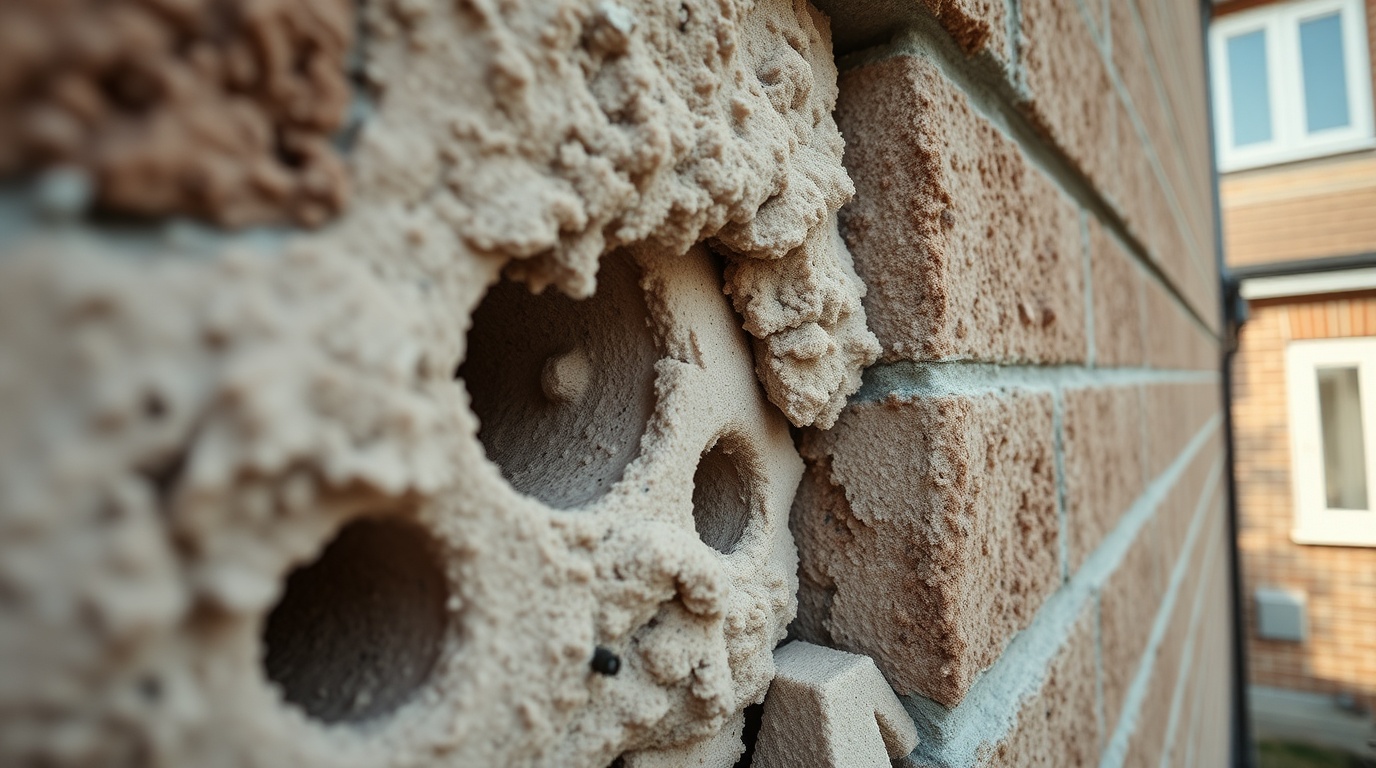
Inside a failed cavity, a borescope typically reveals one or more of: a void where fill has slumped away from the top of the wall; uneven, clumped fill with gaps from a poor installation; discoloured, matted or wet material that has absorbed water; and mortar snots or debris bridging the two leaves so rain can cross. Healthy fill looks uniform, dry and evenly distributed, filling the cavity from top to bottom and touching neither leaf in a way that carries water. Failure shows as the opposite — patchiness, settlement, saturation or bridging. A surveyor drills small holes at different heights to build a picture, because faults often vary across the wall rather than being uniform.
You cannot judge cavity fill from outside; the truth is inside the wall. A borescope inspection shows the actual condition, and the faults fall into a handful of recognisable forms.
What failure looks like
- Voidempty gap, usually at the top
- Clumpinguneven lumps and missed areas
- Saturationdark, matted, wet material
- Bridgingmortar or debris across cavity
- Healthy filluniform, dry, full height
Voids and slumping
The most common sight is a void — an empty stretch of cavity where the fill should be. With slumping, this gap sits near the top of the wall because the material has settled downward, leaving the upper section bare while the lower cavity is over-packed. Poor original installation can also leave voids anywhere: behind obstructions, around joists, or where the injection nozzle missed. Through the borescope a void looks like open masonry — you can see the back face of the outer leaf and sometimes daylight or the inner blockwork. Voids mean lost insulation in that zone and, if positioned over a cold internal area, explain a cold patch and condensation. The size and position of a void tell the surveyor a good deal: a clean band of empty cavity across the top of the wall with densely packed material below is the classic slumping signature, caused by the fill consolidating under its own weight or after repeated wetting and drying. Scattered, irregular voids at mid-height instead suggest the original injection was patchy — too few drill points, blocked flow around wall ties or joist ends, or the installer working too fast. Either way, an empty cavity behind a cold internal patch is the single most direct visual confirmation that lost insulation, rather than condensation alone, is chilling that part of the wall.
Wet, clumped and bridging fill
Where the fill is present but failed, it looks different from sound material:
- Saturated fill appears darkened, matted and heavy, sometimes with visible water staining on the masonry behind — a sign it is conducting heat and may be bridging moisture.
- Clumped or bridged bead shows uneven density, with lumps touching both leaves and gaps between them.
- Mortar snots — blobs of mortar squeezed into the cavity during the original build — can sit across the gap and carry water even where the insulation itself is sound.
- Debris and rubble at the cavity base can block weep holes and trap water.
| Borescope finding | Likely fault | Consequence |
|---|---|---|
| Open gap at top | slumping | cold band, condensation |
| Dark, matted fill | saturation | cold and penetrating damp |
| Uneven lumps / gaps | poor installation | patchy cold spots |
| Mortar across cavity | build bridging | localised damp track |
Indicative findings. Source: CIGA / surveyor inspection guidance.
How the inspection is done well
A thorough borescope survey is systematic, not a single peek. The surveyor drills several small holes at different heights and across several elevations — including the most exposed, weather-facing walls where failure is likeliest — to see whether faults are local or widespread. They note the fill type (mineral wool, polystyrene bead, or foam), its condition (dry, damp, slumped, clumped), and any bridging. Holes are made discreet and reinstated afterward. Pairing the borescope with thermal imaging from inside helps target the worst zones, so the holes are drilled where the cold patches actually are rather than at random. Good practice is also to inspect low down near the damp proof course, where slumped fill and debris collect and can bridge the DPC, and high up near the wall plate, where slumping leaves its tell-tale void. The surveyor records each finding by location and height so the report reads as a map, not a single anecdote. The output is an honest picture of what is in the cavity across the wall, which is essential before deciding whether to leave the fill alone, clear only the bridging debris at the base, top up a localised void, or extract the lot and re-insulate.
How the material type changes the picture
What "failed" looks like depends partly on which material was injected, and a good surveyor reads the cavity with that in mind. Blown mineral wool appears as a fibrous mat; when sound it is light and evenly spread, but failure shows as matting, compression and dark damp staining where it has absorbed water, and as a clean void above where it has slumped. Polystyrene bead looks like loose white or grey spheres; sound bonded bead holds together, while failed bead shows loose drifts, gaps and clumps that can pile against one leaf and leave bare patches elsewhere, sometimes pouring out of the borescope hole if unbonded. Urea-formaldehyde foam, used in many older installations, sets as a solid mass; over decades it can shrink, crack and crumble, leaving fissures and a powdery debris that no longer insulates evenly. Recognising the material also matters because it governs how the fill would be removed if extraction is needed — beads are vacuumed, mineral wool is brushed and drawn out, and degraded foam often has to be physically broken up. So the borescope survey is not just a pass-or-fail check; it records the material, its condition and the failure mode, which together inform whether the cavity should be left, cleared at the base, or fully extracted and re-insulated.
Frequently asked questions
Do I need to remove plaster to inspect the cavity?
No. A borescope only needs a small drilled hole through a mortar joint, which is reinstated afterward. The camera does the rest, so internal plaster and decoration are left intact.
Can a surveyor tell what material is in my cavity?
Yes. Through the borescope they can usually identify mineral-wool batts or fibres, polystyrene beads, or foam, and judge whether it is dry, slumped, clumped or saturated. The material type affects both failure risk and how it would be extracted.
Is wet fill always a failure?
Wet fill that is bridging moisture to the inner leaf is a failure, because it carries damp inside. Slightly damp fill near a localised defect may dry once that defect is fixed, so the surveyor judges severity and source, not just the presence of moisture.
Sources & further reading
Figures on this page are typical UK ranges drawn from published sources and depend on your specific property. They are guidance, not a quotation.